


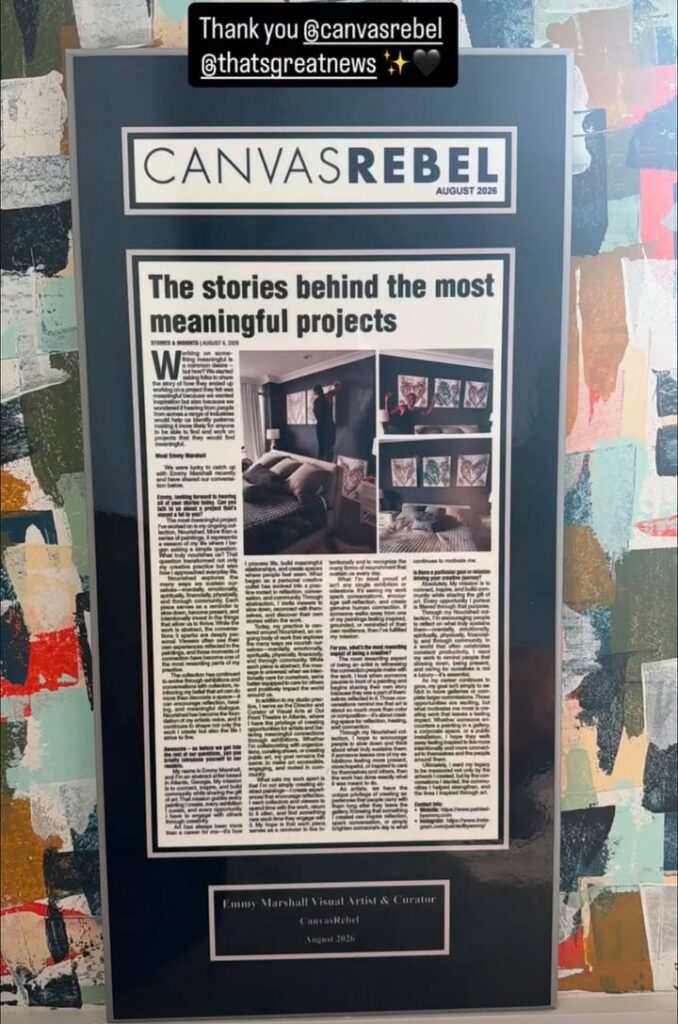
Recognition can happen in an instant. An employee receives an award. A company is featured in the news. A professional earns an honor. A milestone is announced.
But what happens after that moment?
Too often, the recognition becomes a digital notification, an email, or a newspaper that eventually gets thrown away.
Framed awards offer a different way to preserve recognition. They turn an accomplishment, article, photograph, certificate, or other meaningful piece of evidence into something that can be displayed and remembered for years.
While many corporate recognition case studies focus on employee engagement platforms and digital recognition programs, there is another part of the recognition story worth examining: what happens to recognition after it has been given?
That’s where physical recognition can make a difference.
At That’s Great News, we’ve seen customers take meaningful moments—from newspaper features to professional achievements—and turn them into permanent displays.
This article looks at real customer examples and what they show about the role framed awards and custom recognition plaques can play.
What Do Framed Awards Add to a Recognition Program?
A recognition program doesn’t have to be entirely digital or entirely physical.
Digital recognition can make it easy to announce an accomplishment, congratulate an employee, or share an achievement with an entire organization. A physical award can preserve that same moment beyond the original announcement.
Think of it as two layers:
Digital recognition creates the moment.
A physical award preserves the moment.
A framed award can remain in an office, reception area, conference room, recognition wall, or even someone’s home. Instead of being something that is seen once and forgotten, the accomplishment can remain visible.
For companies, that can make a recognition display part of the workplace environment itself.
TGN Customer Example #1: Recognition Worth Returning To
One That’s Great News customer has used the company several times over the years to preserve meaningful recognition.
The process was straightforward. The customer provided a link to the actual article, and That’s Great News transformed the published recognition into a professionally presented plaque.
What stood out most was how the customer described the finished piece: a “priceless memory.”
That tells us something important about physical recognition.
The plaque didn’t create the accomplishment.
The accomplishment had already happened.
The article had already been published.
The recognition already existed.
The plaque gave that recognition a permanent physical form.
For someone who has received meaningful professional or personal recognition, that distinction matters. The value isn’t necessarily in creating another award. It’s in preserving something that already has meaning.
TGN Customer Example #2: Kim Taylor’s Professional Recognition
Kim Taylor received an honor that was covered by her local newspaper.
Instead of allowing the newspaper article to become something that would eventually disappear into a stack of old newspapers, she chose to memorialize the recognition with a wooden plaque.
She described the process as easy, praised the professionalism of the staff, and said she would “cherish” the plaque for years.
This example illustrates an important distinction between recognition and recognition preservation.
The newspaper had already documented the achievement.
The plaque made it possible to keep and display that documentation.
For professionals, business owners, employees, and organizations, a physical display can give an accomplishment a presence that a newspaper clipping or digital article doesn’t necessarily have.
TGN Customer Example #3: From Newspaper Recognition to a Permanent Display
Another useful example comes from Mindi DeLancey of Cornerstone Primary Care.
Mindi had been featured in The Pine Belt News. Her original idea was essentially to remove the article from the newspaper and put it into a conventional frame.
Instead, the recognition was professionally transformed into a finished display.
The transformation is simple to understand:
Before
An important media feature existed as part of a newspaper.
After
The recognition became a professionally presented piece designed to be displayed and preserved.
Again, the important point isn’t that the plaque created the achievement.
The achievement already existed.
That’s Great News helped turn the evidence of that achievement into something physical.
This is one of the reasons custom framed awards can be particularly meaningful. They can preserve the story behind an accomplishment rather than simply displaying a person’s name and an award date.
TGN Customer Example #4: When Recognition Includes More Than One Piece
Not every recognition project starts with a single certificate.
The Heidi Rasor project is an example involving multiple pieces of published material, photographs, and personalized information.
Projects like this demonstrate that a custom recognition display can involve more than simply putting a document behind glass.
When multiple pieces tell the story of an accomplishment, the design has to answer several questions:
- What should people notice first?
- Which information explains the achievement?
- Which photograph provides context?
- What information needs to remain readable?
- How should everything fit together?
That’s a real design challenge.
The finished award needs to communicate the accomplishment while still functioning as something people will want to display.
What These Framed Award Examples Have in Common
The customers above have different stories, accomplishments, and recognition experiences.
But there is a common thread:
The recognition already mattered before it became a physical award.
That’s an important point for companies considering framed awards for employee recognition.
A recognition award doesn’t have to manufacture significance.
Instead, it can capture significance that already exists.
A newspaper feature, professional honor, company milestone, photograph, certificate, or other accomplishment can become the foundation for a physical recognition display.
The result is something that can continue telling the story long after the original recognition event.
Framed Awards as the Physical Layer of Recognition
Many modern recognition programs rely heavily on digital tools.
Employees might receive:
- Digital badges
- Recognition emails
- Internal announcements
- Social recognition
- Points or rewards
- Messages from managers
- Online awards
These tools can be useful because they make recognition fast and easy to distribute.
But physical recognition serves a different purpose.
A framed award doesn’t disappear when someone closes an email.
It doesn’t require logging into a platform.
It doesn’t sit buried beneath hundreds of newer notifications.
It’s there.
A framed award can be placed somewhere people naturally see it.
For an employee, that might mean displaying it in an office or at home.
For a company, it could become part of a reception-area display, conference room, employee recognition wall, or workplace branding.
This doesn’t mean physical awards should replace digital recognition.
Instead, companies can use both.
Digital recognition can spread the message. Physical recognition can preserve it.
Why Companies May Want Recognition That Stays Visible
Recognition is often treated as an event.
Someone receives the award, everyone applauds, photographs are taken, and the moment is over.
But the accomplishment itself doesn’t disappear.
A physical award can help keep that accomplishment visible.
Imagine walking into a company reception area and seeing a collection of framed newspaper articles recognizing employees or the organization.
Visitors can see the company’s accomplishments.
Employees can see the achievements of their colleagues.
New team members can see examples of what the organization values.
And the people who earned the recognition have a physical reminder of the accomplishment.
That’s a very different experience from receiving a notification and moving on to the next task.
Framed Awards Can Preserve the Story Behind the Achievement
Traditional awards often communicate a basic message:
Person + achievement + date.
A custom framed award can potentially communicate much more.
It can include the original article.
It can incorporate photographs.
It can preserve publication coverage.
It can include personalized information.
It can show the context surrounding the accomplishment.
That’s particularly useful when the recognition itself has a story worth telling.
For example, a newspaper article doesn’t simply say that someone was recognized. It can show why they were recognized and how the achievement was presented publicly.
Preserving that original material gives the finished display a sense of authenticity.
What the Numbers Tell Us About That’s Great News
The broader recognition industry includes many different types of awards and programs. That’s Great News brings a more specific perspective: preserving meaningful recognition through custom plaques.
According to the information available for this case study, That’s Great News has:
- Been serving customers since 2003
- Sold or shipped 500,000+ plaques
- Worked with customers who return multiple times over several years
- Created custom recognition projects that vary in size, materials, and complexity
Those numbers provide useful context, but they shouldn’t be turned into claims that aren’t supported by measured data.
For example, we shouldn’t claim that a framed award increases employee retention by a specific percentage unless there is company-specific research demonstrating that result.
Instead, the customer examples tell a more authentic story.
They show that people value the opportunity to preserve recognition physically.
How Companies Can Use Framed Awards
A framed recognition display doesn’t have to be limited to a traditional employee-of-the-month award.
Companies can use custom framed awards to preserve a variety of accomplishments.
1. Employee achievements
Recognize employees for meaningful accomplishments, milestones, or contributions.
2. Media recognition
Preserve newspaper articles, magazine features, and other published coverage.
3. Professional honors
Turn professional recognition into a permanent display.
4. Company milestones
Document important moments in a company’s history.
5. Recognition walls
Create a collection of awards that showcases employees and organizational accomplishments.
6. Office displays
Place meaningful recognition in reception areas, conference rooms, offices, or other visible spaces.
7. Personal professional recognition
Not every award has to stay at the workplace. Professionals may choose to display their accomplishments at home or in a private office.
The common idea is simple:
Take something meaningful and give it a form that can last.
What Makes a Custom Framed Award Different?
A generic trophy can recognize that someone won.
A custom framed award can help explain what they accomplished.
That’s especially true when the award incorporates the original source of recognition.
Instead of creating something disconnected from the accomplishment, the design can preserve the evidence of it.
That might be:
- A newspaper article
- A magazine feature
- A photograph
- A certificate
- A published announcement
- A professional achievement
- Multiple pieces of recognition combined into one display
This approach makes the finished piece more personal.
It’s not simply an award.
It’s a physical record of the achievement.
The Real Value of a Framed Award May Come After the Ceremony
This is perhaps the most important lesson from these customer examples.
Companies often think about recognition in terms of the moment it is presented.
But the more interesting question may be:
What happens after the recognition is given?
An email can get buried.
A digital notification can disappear.
A newspaper can eventually be discarded.
A physical award can remain.
It can sit on a wall and become part of someone’s workspace.
It can be seen by coworkers and visitors.
It can be taken home.
It can become something a person keeps for years.
That doesn’t make a physical award better than digital recognition in every situation.
It simply gives recognition another dimension.
From Achievement to Recognition to Preservation
The strongest way to think about framed awards is as a progression:
Achievement ? Recognition ? Physical Preservation ? Continued Visibility
First, something meaningful happens.
Then the person or organization receives recognition.
Then that recognition is preserved in a physical format.
Finally, the accomplishment continues to be visible long after the original moment.
That’s the part that many recognition case studies overlook.
They focus on how organizations deliver recognition.
But there’s another question worth asking:
What happens to the recognition afterward?
Final Takeaway: Don’t Let Important Recognition Become a Forgotten Moment
The best recognition isn’t necessarily the most expensive award or the most elaborate ceremony.
Sometimes, it’s simply about preserving a moment that already matters.
The customer examples from That’s Great News show several different ways people have done exactly that—from newspaper recognition and professional honors to multi-piece displays containing articles, photographs, and personalized information.
For companies, framed awards can provide a physical layer to an otherwise digital recognition strategy.
For employees, they can create something tangible to keep.
For organizations, they can become part of the visual history of the company.
And for the person being recognized, they can turn a moment of achievement into something that remains visible for years.
The ceremony may last an hour. The recognition can last much longer.
A custom framed award helps make sure the story doesn’t disappear when the ceremony ends.
Frequently Asked Questions About Framed Awards
What is a framed award?
A framed award is a recognition piece presented in a frame or custom display. Depending on the project, it can incorporate certificates, articles, photographs, personalized information, or other materials connected to an achievement.
Can companies use framed awards for employee recognition?
Yes. Companies can use framed awards to recognize employee achievements, professional milestones, media recognition, company accomplishments, and other meaningful moments.
What can be included in a custom framed award?
Depending on the project, a custom award may include newspaper or magazine articles, photographs, certificates, logos, personalized information, and other materials that help tell the story of the accomplishment.
Are framed awards better than digital employee recognition?
They serve different purposes. Digital recognition makes it easy to communicate accomplishments quickly, while physical awards provide something tangible that can remain visible and preserved.
Where can a company display framed awards?
Companies can display them in reception areas, employee offices, conference rooms, recognition walls, hallways, or other spaces where employees and visitors can see them.
Why preserve a newspaper or magazine article as an award?
A published article provides original evidence and context surrounding an accomplishment. Turning it into a professional display can make that recognition easier to preserve and showcase for years.
Looking for a Way to Preserve an Achievement?
Whether you’re recognizing an employee, preserving a media feature, celebrating a professional accomplishment, or documenting an important company milestone, a custom plaque can turn recognition into something tangible.
The achievement has already happened. Now you can preserve the story behind it.