


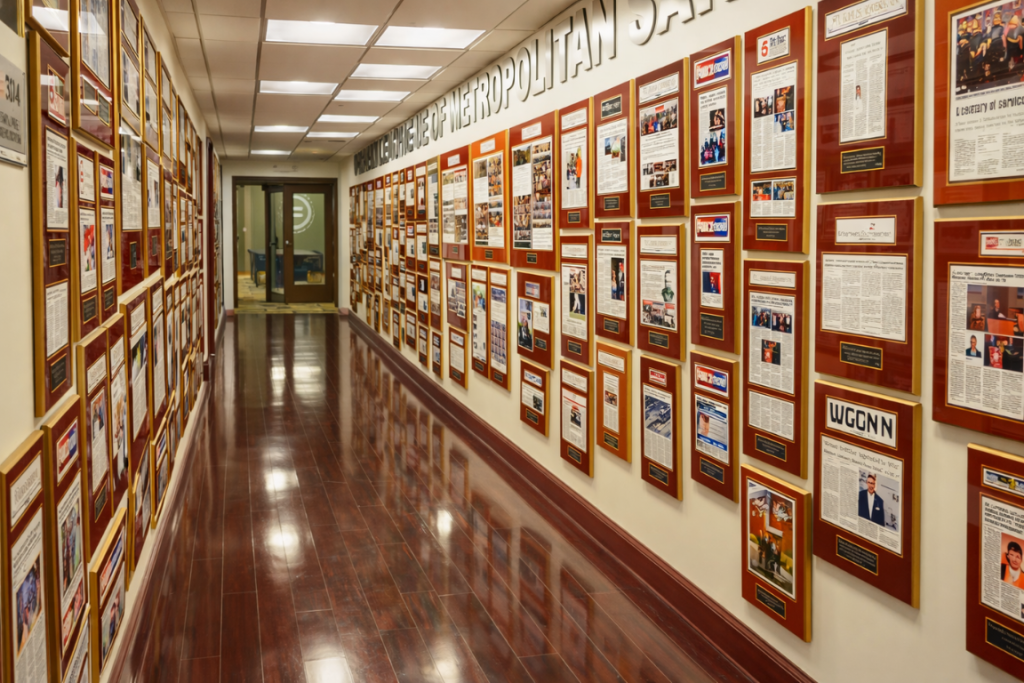
The Quiet Shift From One Recognition to a Life of Moments
It Never Starts as a Collection
The first plaque usually stands alone.
Centered carefully.
Given space.
Treated like a finished moment.
At that stage, the wall feels complete.
Nothing suggests there will be another one.
Then Time Passes
A second recognition arrives months later.
Maybe years later.
A new article.
A new feature.
Another moment worth preserving.
The wall changes quietly after that.
Not dramatically.
Just enough to begin forming a pattern.
One Plaque Creates Memory. Multiple Plaques Create Time
A single plaque captures a specific achievement.
But when several begin appearing together, something else happens:
The wall starts showing progression.
Not just what happened—
but when it happened.
The display becomes chronological without needing dates explained.
The Gaps Begin to Matter
As more plaques are added, spacing becomes intentional.
The distance between pieces starts shaping the story visually.
A larger gap might represent years between milestones.
Closer spacing might reflect a period of rapid growth.
The empty space becomes part of the timeline too.
Different Versions of the Same Person
Over time, plaques often reflect different phases of life:
A first publication
A promotion announcement
A business feature
An industry recognition
The wall begins showing evolution—not repetition.
Each plaque preserves a different version of the person connected to it.
The Room Changes With the Wall
At first, the wall simply holds décor.
Later, it begins holding history.
Visitors notice it differently.
What once looked like a single display now feels layered with time and continuity.
Explore plaque layouts and styles:
https://www.thatsgreatnews.com/Sample2
Browse custom recognition displays:
https://www.thatsgreatnews.com
Some Walls Grow Slowly
Not every timeline develops quickly.
Some walls gain one plaque every few years.
That slow pace changes the feeling entirely.
Each addition carries more weight because the space remained unchanged for so long before it arrived.
Alignment Starts Becoming Ritual
Something subtle happens after the third or fourth plaque.
People begin caring deeply about alignment.
Measurements become precise.
Spacing becomes deliberate.
Placement decisions take longer.
Because the wall no longer feels temporary.
It feels established.
The Earliest Plaque Always Feels Different
Even as the collection grows, the first plaque rarely loses significance.
It becomes the anchor point.
The beginning of the timeline.
Everything added later quietly connects back to it.
The Wall Stops Feeling Empty
At some point, the wall reaches a balance where it no longer feels like open space waiting to be filled.
It feels complete—but still open to continuation.
That’s the difference between decoration and documentation.