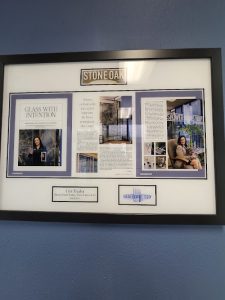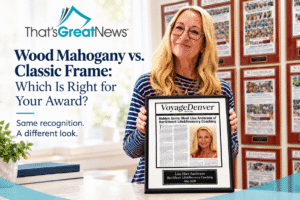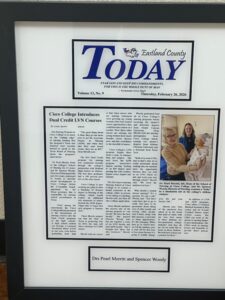
If you want to design your own framed award, start with the story or achievement you want people to see, not with the frame itself. Decide what deserves the most attention, how much original material you want to preserve, and how large the finished piece needs to be to make everything readable from the wall. At That’s Great News, we help customers turn published articles, photographs, logos, and other achievements into finished display pieces, including locating the published article when the customer knows what they want to preserve.
Start With What You Want to Preserve
The best framed awards usually begin with something that already has meaning.
That might be a newspaper article about your business, a magazine feature, a professional achievement, a photograph, a special recognition, or several pieces of coverage that you want to display together.
This is where designing your own award is different from simply ordering a standard trophy.
Instead of starting with a blank plaque and trying to figure out what words to put on it, start with the material that tells the story.
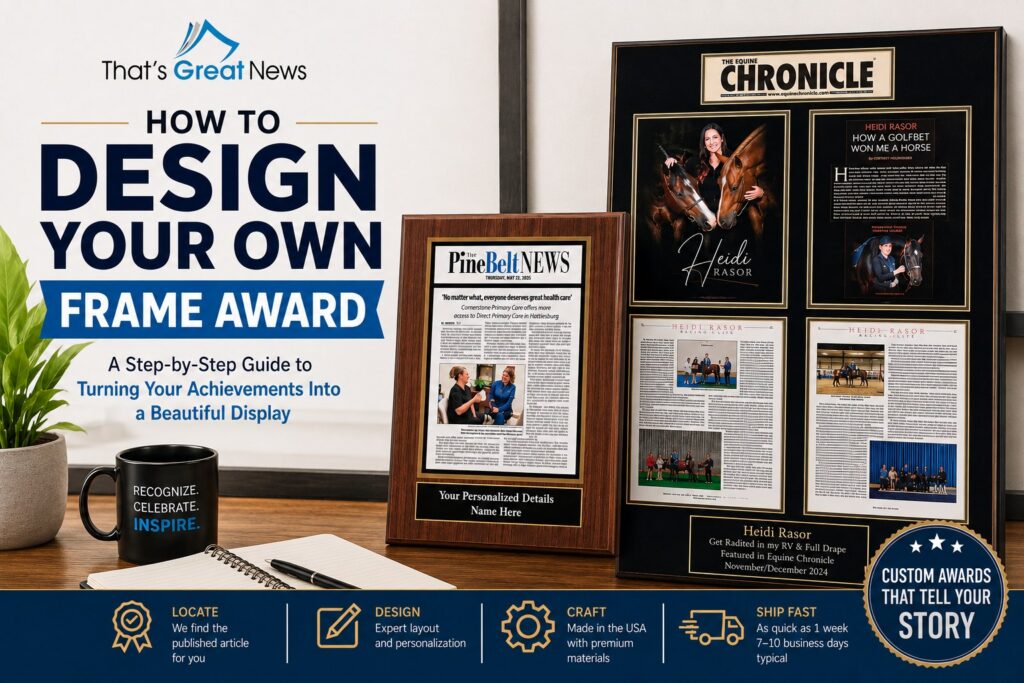
For example, one of our customers, Mindi DeLancey of Cornerstone Primary Care, had already thought about cutting an article about her clinic out of the newspaper and framing it herself. The article appeared in The Pine Belt News. Instead, she chose to have it turned into a professionally presented plaque.
Her review captured exactly why this approach matters. She said she had considered cutting out and framing the newspaper article herself, but when she saw our product, it was a perfect fit and allowed her to preserve the article in a professional and attractive way.
That is a good starting point for your own design: don’t ask only, “What should my award say?” Ask, “What part of this achievement do I want people to remember?”
Decide What Should Be the Main Feature
A common mistake is trying to make every element equally important.
If your award contains a newspaper article, photographs, a logo, a headline, a recipient’s name, and additional text, everything cannot compete for attention.
Choose one primary element.
For a media-feature award, that might be the published article. For a personal achievement, it might be a photograph. For a business recognition piece, the company’s accomplishment or logo might deserve more emphasis.
Then use the other elements to support it.
This sounds simple, but it is one of the most important design decisions because a wall display has to communicate its purpose quickly. Someone walking past it should understand what they are looking at without having to study every line.
Don’t Design Only for Your Computer Screen
This is one of the biggest things customers learn once they see their finished award in person.
The physical size can be much more substantial than it looks on a computer screen.
In our experience, framed and plaque-style projects commonly start around 16×20 inches and can go as large as 30×30 inches, depending on the amount of content and the customer’s display needs.
That size matters.
A full newspaper article may look perfectly reasonable when viewed on a monitor. Add photographs, a publication name, personalized information, borders, spacing, and the surrounding frame, and suddenly you need considerably more physical space.
When choosing a size, think about:
- How much original content needs to remain readable
- How many photographs you want to include
- Whether a logo needs room to breathe
- Where the award will hang
- How far away people will normally view it
- Whether the finished piece should make a strong visual statement or fit into an existing wall display
A design that technically fits is not necessarily a good design.
The goal is to give every important element enough room to look intentional.
Think About the Whole Wall Display
Another mistake is thinking about the inside of the award without thinking about the finished object.
The frame, plaque material, borders, photographs, article, typography, and personalized details all need to work together.
For example, if the original newspaper article already contains a lot of visual information, adding too many decorative elements can make the award feel crowded.
On the other hand, a large piece with only a small amount of content can feel unfinished.
The right size and layout depend on the relationship between the content and the physical presentation.
That is why we don’t look at a published article as just a file to print. We look at how that article needs to work as part of a finished display.
A Published Article Can Become the Centerpiece
For customers preserving media coverage, there is another advantage to working with a company that handles the article as part of the process.
You don’t necessarily have to start with a perfect high-resolution copy sitting on your computer.
At That’s Great News, customers can identify the published article they want to preserve, and we’re able to locate the article and use it as part of the design process.
That can make a major difference for someone who remembers seeing an article but doesn’t have the original newspaper or a clean digital file.
It also means the project is about more than printing something that the customer already designed.
The goal is to take the original published material and turn it into something that is appropriate for permanent display.
You Can Combine More Than One Piece of Coverage
One of our projects for Heidi Rasor is a good example of what happens when a customer has more than one piece of important coverage.
Instead of displaying one article by itself, her finished HD Metal Black plaque brought together multiple pieces of published material, photographs, and personalized information into one substantial display.
That creates a different design challenge.
When there are several pieces to preserve, the layout has to give each one enough room while still making the entire award feel like one piece.
The answer isn’t necessarily to make everything smaller so it all fits.
Sometimes the better answer is to make the award larger.
That is one reason large-format pieces can make sense for customers who want to preserve several photographs or articles without reducing everything to a size that is difficult to read.
Keep the Personalization Focused
Personalization is important, but more personalization isn’t automatically better.
A name, date, accomplishment, company name, or short message can give an award context that the original article doesn’t have.
But you don’t need to explain the entire story in a paragraph if the published article already tells the story.
Think of the personalized section as the information that helps someone understand who the award belongs to and why it matters.
Let the original achievement carry its own weight.
How Much Does a Custom Framed Award Cost?
There isn’t one universal price because the cost depends on the size, materials, amount of content, and complexity of the finished design.
For the types of custom plaque projects we produce at That’s Great News, customers can expect pricing in roughly the $169–$399 range.
A smaller, simpler project will naturally be different from a large display containing several photographs, an entire published article, and multiple personalized elements.
The important thing is to design around the content first rather than choosing the cheapest size and then trying to force everything into it.
How Long Does It Take?
Speed is another consideration when designing a custom award.
At That’s Great News, we’re able to create these pieces in the U.S. and move the process quickly so customers aren’t waiting weeks or months just to have an important achievement put on display.
Depending on the project, a customer may receive their piece on a timeline as quick as about one week. For projects such as Heidi’s, shipping was in the 7–10 business-day range.
That matters when the award is being created for a celebration, presentation, office opening, retirement, recognition event, or another date that is already on the calendar.
If you have a specific deadline, it is worth bringing that up before ordering rather than assuming every custom project has the same turnaround.
What You Actually Need to Get Started
You don’t need to be a graphic designer to create a meaningful framed award.
Start with four things:
- The achievement or story you want to preserve.
- The original article, photograph, or other material, if you have it.
- The personalization you want included, such as a name, date, company, or short message.
- An idea of where the finished piece will be displayed.
From there, the design can be built around the actual content.
If you have a published article but don’t have the original copy, identify the publication and article and let the design team work from there. If you have several pieces of coverage, photographs, or other material, tell the designer what you consider most important rather than trying to make every item equally prominent.
The Best “DIY” Design Decision May Be Knowing What Not to Design Yourself
There is nothing wrong with wanting control over your own award.
You should know what you want preserved, what the award should commemorate, how you want it to feel, and where it will be displayed.
But designing a framed award isn’t the same as designing a social media graphic.
The finished piece has physical dimensions, materials, depth, readability, and wall presence that you can’t fully judge from a screen.
That’s why the most useful approach is often to design the idea yourself and let the physical design be refined around it.
At That’s Great News, we’ve seen the difference that makes firsthand—from a customer who originally planned to cut a newspaper article out and frame it herself, to a larger multi-piece display like Heidi Rasor’s that combines multiple pieces of coverage into one finished award.
Your achievement already has the story.
The job of the award is to make sure that story is presented in a way that feels worthy of keeping on the wall.